Buzz word warning:
The overused words ‘analytics’ and ‘machine learning’ will be mentioned in this article.
A machine learning model I built compared AJ Brown to Amari Cooper when they were NFL Draft prospects.
That got your attention, didn’t it? Drafts are littered with comparisons, or ‘comps’, for aspiring professional athletes. At the very least, an analyst will say, “When I watch this kid he reminds me of…” you fill in the blank.
We love to compare. Why not be precise when we do it? This article aims to do just that.
Machine learning is a vast world inside the analytics sphere. Yes, not all analytics are the same. There is a litany of methods to come to a conclusion, some more appropriate than others, just like in the real world.
So, how can we generate a precise method for getting a glimpse at what a college prospect could become at the next level?
A very intuitive way to do that would be through the k-nearest neighbor (KNN) algorithm. Don’t worry, I won’t get into the minutia here. Here, KNN boils down to using graphs and math to determine who is closest (or is a neighbor) to who based on a set of quantifiable criteria.
(If you’d like to learn more about the k-nearest neighbor algorithm you can follow this link, or just Google it.)
If we’re determining who’s a neighbor with who, couldn’t that be thought of as similarity and is grounds for a comparison? If you’re very similar to someone else, then you two are comparable in some way.
For this exercise, we’ll use collegiate production and a variety of physical attributes to create comparisons for NFL Draft prospects. Here, let’s focus on the wide receivers in the 2020 class.
For instance, let’s compare Henry Ruggs III to John Ross using a few attributes in the model.
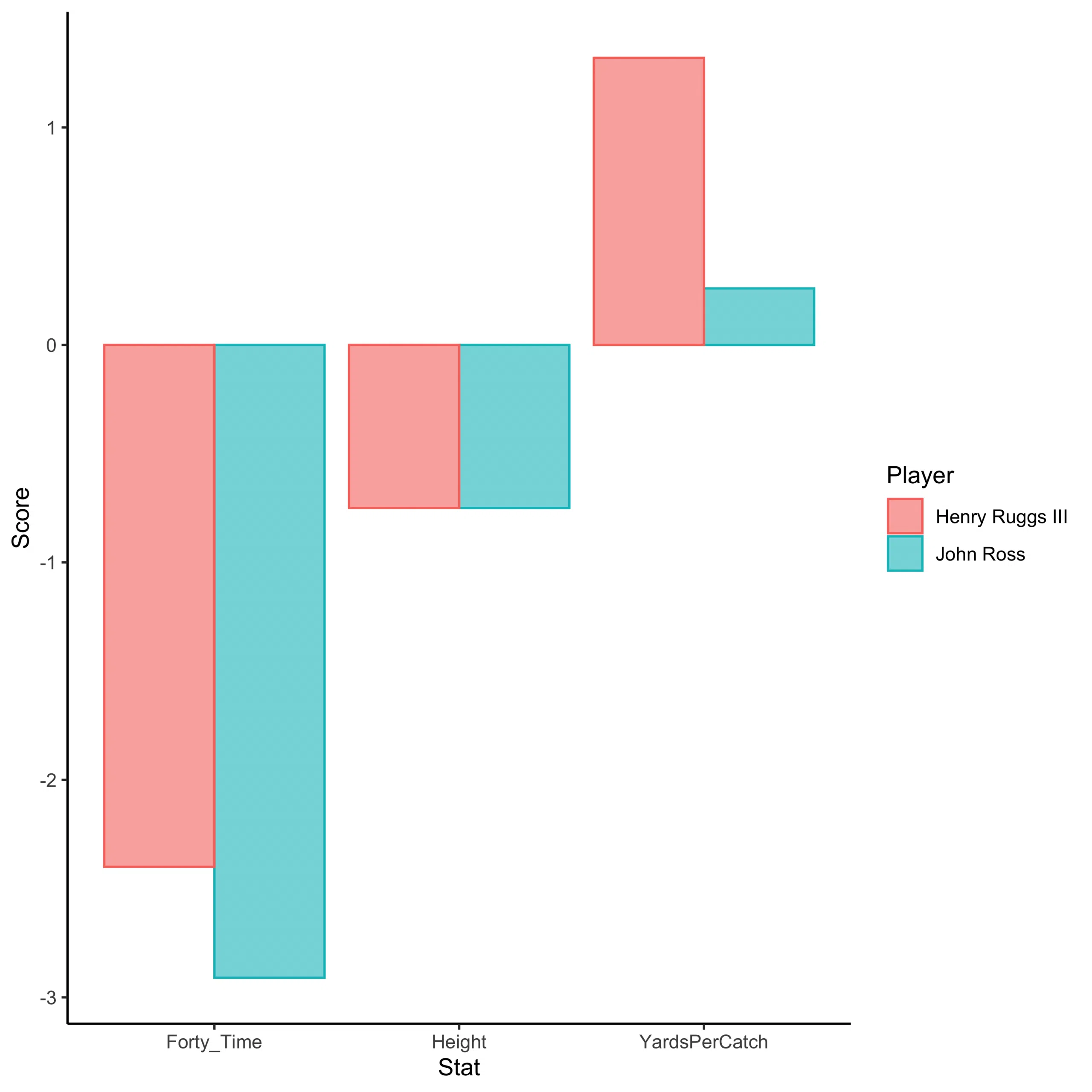
You’ll notice they’re very similar in terms of the 40 Yard Dash Speed and Height, but Ruggs was more efficient with his catches in college. You’d expect them to be fairly similar based on this.
This model accounts for more than just those characteristics, but I hope that example makes this a bit more tangible.
Since this is a Nashville-based website, we’ll focus on a position I think the Titans need to address in this upcoming cycle. It isn’t looking like they’ll pick up Corey Davis’ fifth-year option and Tajae Sharpe was not retained in free agency. Who in this class should the Titans be targeting?
Before you read the following list of comparisons, please heed the following:
1. I am willing to acknowledge this is not infallible.
2. Comparisons to pro players get skewed by humans because of a player’s success in the NFL versus what they were as a prospect.
3. Success in the NFL is GREATLY impacted by the situation a player walks in to.
4. Just because a player is compared to another player does not mean I or ‘analytics’ think the two are exactly alike. The math tells you the room for inaccuracy within its estimate. (This is applicable to essentially all ‘analytics’.)
The scale for confidence in a comparison is as follows:
Not confident – The comparison between these two players was not significant given the data the model was trained on.
Fairly confident – It’s a fair comparison, but not one to write home about.
Moderately Confident – These two players are likely similar in more than a few ways.
Confident – These two players likely have very similar attributes in several ways.
Very confident – These two players are comparable to the highest degree.
Like I said at the beginning, this model said the best comparison for AJ Brown was Amari Cooper. Based on AJ Brown’s rookie year that looks like a good comparison. However, the confidence in that comp was only moderately strong.
Do these comps tell exactly how a player will pan out? No. Do they offer a glimpse into the production and skill set a player can bring to an NFL offense by comparing to players who’ve already been in the league? Yes.
So, here are several 2020 NFL Draft eligible Wide Receivers and their closest comps.
Henry Ruggs III – John Ross (Confident)
Jalen Reagor – Josh Huff (Confident)
Donovan Peoples-Jones – Ricardo Louis (Confident)
Kalija Lipscomb – Ty Montgomery (Fairly confident)
CeeDee Lamb – Josh Reynolds (Moderately Confident)
Jerry Jeudy – Josh Reynolds (Not confident)
Justin Jefferson – Nelson Agholor (Fairly confident)
Devin Duvernay – Malcolm Mitchell (Moderately confident)
Marquez Callaway – Malachi Dupre (Fairly confident)
Brandon Aiyuk – Malachi Dupre (Not confident)
Have a question? Tweet at me @SmithACalvin! Disagree? Tweet at me @SmithACalvin!
This can be related to the expected draft position of a given player, as well. Not every prospect pans out, and some exceed expectations!
Yes, I also found it interesting how CeeDee Lamb and Jerry Jeudy were both compared to Josh Reynolds. Interestingly, Jeudy and Lamb scored very similarly to each other. Don’t be swayed by the Jeudy comparison, though. No prospect in the database I assembled compared closely to Jeudy, which I think bodes well for him.
For Lamb, I don’t think this makes him a bad prospect. Reynolds was a fourth-round pick in 2017 which isn’t disgraceful and has been fairly productive in Los Angeles.
For full transparency, these are the greatest shortcoming of this model.
– Small training sample. Data goes back to 2014 and was trained on a sample of 133 wide receivers.
– The physical attributes are mostly grouped as a whole rather than individually given a lack of open and accurate testing data.




Comments